
०४ · The centre of the spiral
Mahabharat
महाभारत
A one-day workshop can show you the exit. Only a year of structured commitment walks you through it.
Why twelve months
One day changes what you know. A year changes what you do.
Every owner who has attended a good workshop knows the pattern: three weeks of momentum, then the fires return and the notebook goes into a drawer. Mahabharat is built against that pattern. Twelve months, one pillar at a time, in a deliberate order — because vision has to exist before ownership means anything, ownership has to exist before accountability is fair, and accountability has to exist before systems will hold. Each month ends with one documented commitment and a date. We check.
How the year is actually structured
The opening intensiveप्रारम्भ
One full diagnostic day. Vision, the Why Chain, real values named rather than invented, and the honest inventory of what breaks without you. You leave with the thinking book and your first month's commitment written down.
Monthly working sessionsमासिक
One structured session each month, moving through the five pillars in sequence. Every session ends the same way: one specific action, documented, with a deadline, reviewed at the next session. No session opens without the previous month's commitment being accounted for.
The Freedom Auditस्वातन्त्र्य
Twice in the year you score yourself across all eight commitment areas and calculate your Owner Dependency Index. The goal is not to be uninvolved. The goal is to be involved by choice rather than by necessity — and this is how you find out whether that is actually happening.
Vishwaroopam quarterविश्वरूपम्
The final quarter exists only because of the nine months before it. Foundation built, team developed, bottlenecks removed. Now: what does the cleared space reveal? Ansoff mapping, business-model architecture, and the next vision — the one that was not available to you a year ago.
The structure
Five pillars. One year. One transformation.
सामSAAM
Vision & Alignment · Months 1–2
Clarity on where you are going and why. You write the vision the business was always meant to have rather than the one you defaulted into, compress it to a single sentence, and share it with your team. Then you name the values that are already operating in your company instead of the ones on the wall.
“A goal has a deadline. A vision has a direction. You never arrive at a vision.”
दामDAAM
Incentives & Ownership · Months 3–5
Understanding what each key person actually cares about — name, money, or mastery — and building structures that make them behave like owners rather than employees. Recognition that is specific rather than generic. And the autonomy ladder, where you find out how often you have been checking on things that never needed your checking.
“The most expensive sentence in a business is: let me check with the owner first.”
दण्डDANDA
Feedback & Accountability · Months 6–8
The conversations you have been postponing get named, structured and had. Feedback that describes observable behaviour and its impact opens possibility. Judgment closes it. This pillar also covers the performance decisions you have been avoiding, and the three-question protocol you must pass before making one.
“Keeping someone in a role they are not performing in is not loyalty. It is complicity in their mediocrity.”
भेदBHEDA
Process & Systems · Months 9–10
An audit of every recurring process, meeting, approval and report in the business, scored honestly and then cut. Sustainable growth requires systems that produce good outcomes reliably, not heroes who produce great outcomes occasionally.
“The process that protected a ₹20 lakh business may be strangling a ₹2 crore one.”
विश्वरूपम्VISHWAROOPAM
Expanded Vision · Months 11–12
Not all expansion is growth. Expansion into areas where your strength gives you no advantage is distraction wearing a strategy-shaped costume. This quarter identifies what your organisation genuinely does better than ninety percent of competitors, and moves there with precision. Then you write the vision for the year after.
“Transactional businesses create revenue. Recurring businesses create valuation.”
“The goal was never to be uninvolved. The goal is to be involved by choice — not by necessity.”
Who this is for
Mahabharat is for you if —
- —You are a business owner, founder or MD leading a team.
- —You have built something real and know it could work considerably better.
- —You suspect that you are the biggest bottleneck in your own business.
- —You are willing to be uncomfortable in a productive way for twelve months, not twelve days.
- —You are not looking for motivation. You are looking for structure that holds.
Who it is not for
- —You want someone else to do the thinking for you.
- —You want templates, shortcuts, or a framework to copy.
- —You are not ready to confront your own role in the problems your business has.
- —You cannot commit to one session a month for a year. It does not work in fragments.
What you carry out
Twelve months of your own decisions, documented
The 12-month thinking workbook
Yours to write in, return to and measure growth against. Not a note-taking book — a thinking book. The answers you write in month one will look different by month twelve, and that gap is the entire point.
A one-sentence vision statement
Not a mission paragraph. One sentence, present tense, no jargon, that gives you energy every time you read it aloud — and that your whole team has heard.
Your Freedom Audit score
A scored, honest measure of how dependent the business is on you, taken twice, with a clear map of what must change between the two readings.
Twelve documented commitments
Not goals. Not intentions. Specific actions with deadlines, each built on the one before, each reviewed.
A restructured relationship with your team
Grounded in clarity, autonomy, accountability and genuine recognition. Not heroics. Systems.
The next vision
Written in month twelve. The one that was not available to you when you started, because the space it needed had not been cleared yet.
निवेश · Investment
Cohort size is limited. Investment is discussed after your application is reviewed.
पंजीकरण · Registration
Reserve your seat
Fill this in, then complete payment. Your seat is confirmed once payment is received and you will get a confirmation by email within one working day.
भुगतान · Payment
Complete your payment
Pay by card, UPI, net banking or wallet. Both routes go to the same Razorpay account.
image goes here
ACF field
Scan to pay
UPI · Cards · Net banking · Wallets
Amount: the workshop fee. After paying, email your payment reference to inquiry@kurukshetraworkshops.com so we can match it to your registration.

Harshit Shah
Leadership & business consulting

Srishti Shah
Communication & leadership
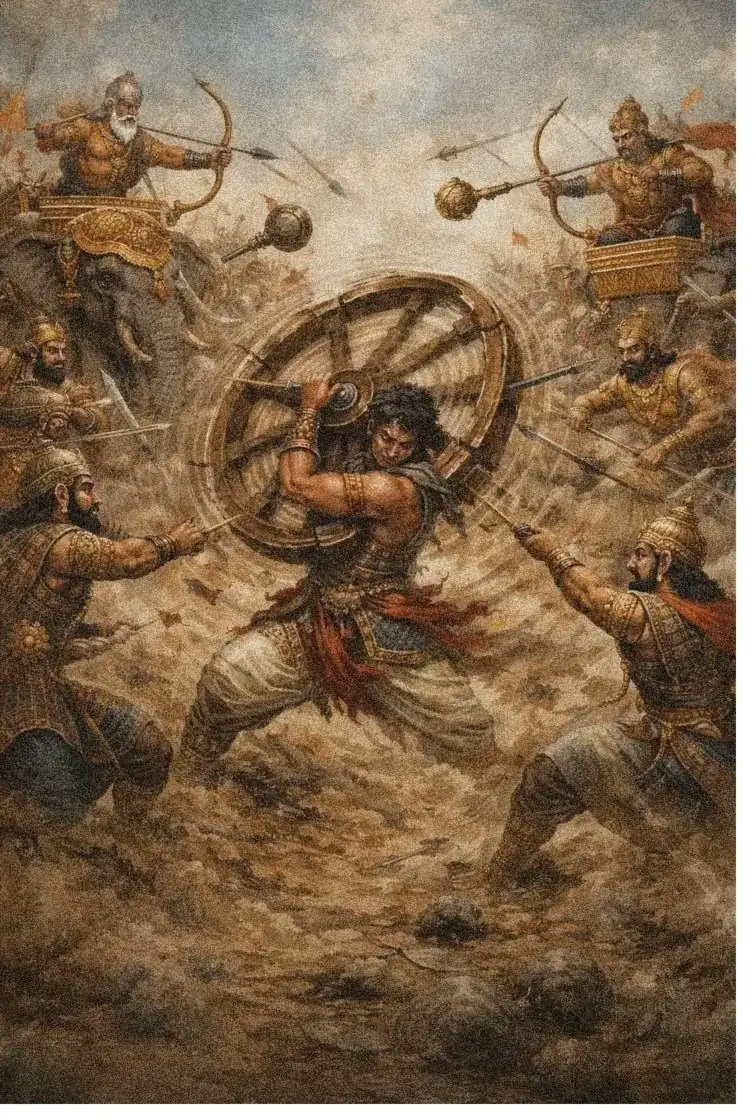
Abhimanyu entered the Chakravyuh. You spend this year learning how to exit yours.
One year. Five confrontations. One business transformed — not because you worked harder, but because you finally worked on the right thing. The battlefield was never outside you. It never was.
Enquire Now → Register Now → Not sure? Take the Diagnostic
|| विजयः भवतु ||
Want this workshop for your team?